 AllergyPass
Malayalam allergy card
Your restrictions in Malayalam and English, ready to save on your phone or print.

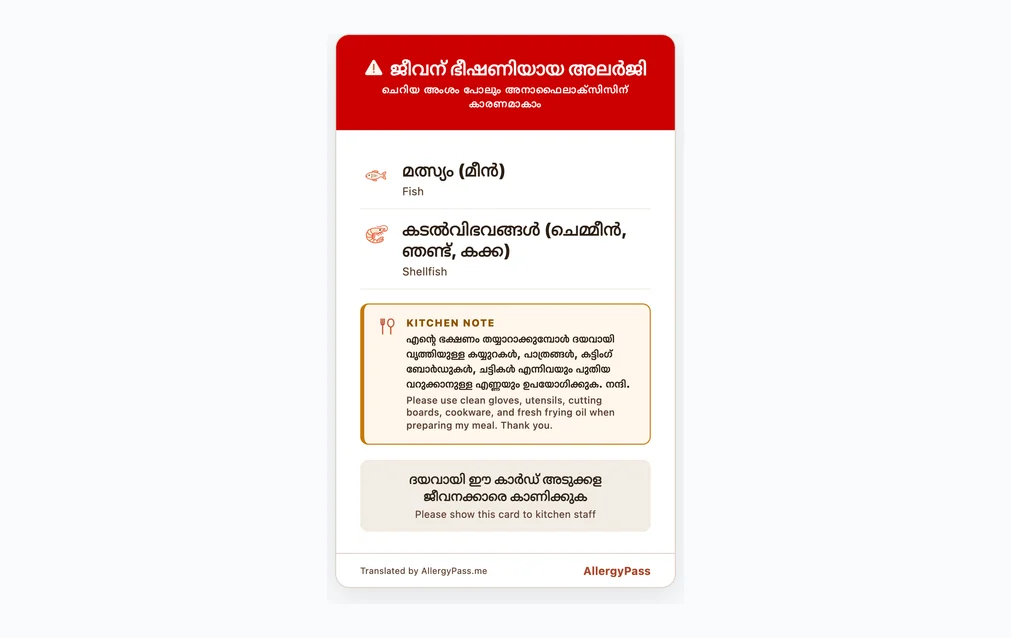
A live sample. Your finished card is personalized in the builder.
Get this card in Malayalam
Your allergens, written in Malayalam for kitchens in Kerala, with the optional cross-contamination warning shown in this sample.
- Printable PDF with a cut-out card, plus an image for your phone
- Every allergen in Malayalam and English, side by side
- Apple and Google Wallet passes for cards with up to three allergens
$7.99 one-time for Malayalam English is free · All Languages $29.99 · instant digital delivery, no shipping charge
Continue with this cardSecure checkout by LemonSqueezy · 14-day refund policy
What is the biggest risk in Kerala?
Kerala cooking leans on a few ingredients that appear almost everywhere and are rarely announced. Coconut is the clearest case: Kerala Tourism notes that coconut is used in almost every recipe in the state's cuisine, as grated filling for stir-fried vegetable dishes, as milk in stews and as the cooking oil. It is the default, which means a cook may not think of it as something worth mentioning. It also falls outside the list of allergens that India's labelling rules require on packaged food (more on that below), so a printed label will not warn you either.
For fish and shellfish, the risk is the coastline on the plate. Fish-head curry, pan-fried karimeen wrapped in banana leaf and prawn roast are the famous dishes, but seafood can also turn up in a gravy that looks like any other red or yellow curry. If you are avoiding fish or shellfish, ask what the base is cooked with, not just whether the dish is "vegetarian". Ask too whether dried or fermented fish is used for seasoning, and whether the pot or the frying oil is shared with seafood. Those are the questions this card is built to open.
Dairy and nuts need the same habit of asking. Ghee is the norm with parippu, the lentil course, at a feast, and payasam, the sweet pudding course, is cooked in cow's milk in some versions and coconut milk in others. Ask whether a payasam or a rice dish has been finished with cashews or other nuts, and whether mustard seed is used in the tempering if that matters to you. Parotta, the layered flatbread, is wheat-based and is worth asking about for egg or milk if those are on your card.
Why written Malayalam beats spoken English
Malayalam is Kerala's official language: the Kerala Official Languages Act, 1969 sets it out alongside English for official purposes. In Kochi, Munnar or Alleppey, hotel and tourist-facing staff will often manage English. The cook behind a counter, a houseboat crew member or the family running a small meals place may not, and a spoken explanation of a seafood allergy loses detail on its way from table to stove.
A printed card removes the middle step. The cook reads the allergen in the language they cook in, you point to it, and the conversation that follows can be short: which dishes are safe, what is in the gravy, what is fried in the same oil. A card cannot promise that a kitchen will accommodate you, and some will say no. A clear refusal is still a better outcome than a polite nod that hid a misunderstanding.
Tamil Nadu next door uses Tamil, not Malayalam. If your route runs from Kerala across the border, you will want the Tamil allergy card for that leg. For the wider picture across the country, the India food allergy hub collects our city guides and safety notes in one place.
Put your selected allergens in Malayalam and English on a card to show kitchen staff.
Make your own Malayalam allergy cardAllergen labelling in Kerala and India
Food law in Kerala is national law. Under regulation 5(14) of the Food Safety and Standards (Labelling and Display) Regulations, 2020, packaged foods must declare known allergens in a "Contains" statement. According to the FSSAI compendium, the list covers cereals containing gluten, crustaceans, milk, eggs, fish, peanuts and tree nuts, soybean, and sulphite at 10 mg/kg or more. Tree nuts, including cashew, are declared as "Nut". A "may contain" line is permitted for cross-contamination. Sesame, mustard and coconut are not on the list.
Restaurants are covered separately. Regulation 9(2)(a) says food service establishments should show allergen information against items on menu cards or boards, and symbols are allowed. Regulation 8(4) asks places that serve prepared food for immediate consumption to display allergen information at the point of sale. Regulation 9(3) exempts some businesses, including event caterers, premises operating fewer than 60 days a year, and special-order or modified items, all in the same compendium.
Here is the caveat: we could not verify how closely any of this is followed in practice, and we did not find a later direction changing it. Do not expect to see allergens printed on a toddy-shop board or a hotel's sadya menu. Treat the rule as a reason to ask, and the answer you get as the thing to rely on.
Real dining situations in Kerala
Sadya on a banana leaf. A sadya is a vegetarian feast served on a banana leaf, with dishes placed in a set order. Because it is a fixed menu served from shared pots, there is little room to leave an item out in the moment. Show the card to whoever is organizing the meal before you sit, ask which dishes contain ghee, coconut milk or nuts, and decide in advance what you will skip. Large hall settings favor the host who knows the menu, not the server pouring curry onto your leaf.
Toddy shops. Toddy shops, or kallu shaps, are casual, local places where the menu may be short, spoken or handwritten in Malayalam, which is exactly where a written card helps most. Fish curries are a common draw, so check. If fish or shellfish is on your card, ask which curries and fried dishes contain them and whether they share a pan with the dish you want.
Houseboats. Houseboat meals are usually cooked by the crew on board. If you have a serious allergy, raise it when you book rather than on the boat, and hand the crew your card at boarding so the cook has read it before the first meal. Ask which oil is used for frying and whether seafood is cooked in the same pots.
Tea shops and bakeries. Fried snacks and filled pastries are sold quickly and rarely come with an ingredient list. A fritter fried in shared oil can pick up traces of whatever went in before it. Ask what is in the filling and what else was fried in the oil before you buy, and pick plain, freshly cooked options when the answer is unclear.
Hotels and larger restaurants. These are the easiest places to be understood. Staff in tourist-facing kitchens are more used to special requests and more likely to read English. Show the card anyway, so the Malayalam is what the cook actually sees.
What happens after you pay
You pick your allergens in the builder, choose whether the card should carry a severe-allergy line and a cross-contact request, and check out. The finished card arrives by email as a printable PDF with a cut-out card and as an image sized for your phone. If your card has three allergens or fewer, you can also add it to Apple or Google Wallet. Nothing is shipped.
Before you travel, read through the allergen list once more, print a spare copy for the houseboat or hotel, and save the image offline so it opens without a signal. One Language covers this one language and destination. If your route also takes in other regions, All Languages covers every language we offer, including ones added later.
If something goes wrong
India has a single emergency number, 112, for police, fire and ambulance. Carry any prescribed emergency medication with you, keep it where you can reach it, and know where the nearest hospital is before a long boat or road day. The India hub covers more on planning ahead.
Frequently asked questions
What do you get with the Malayalam allergy card?
A printable PDF with a cut-out card, plus an image sized for your phone, both emailed to you. Each allergen you select is printed in Malayalam with English beside it. Cards with up to three allergens can also be added to Apple or Google Wallet.
Does the card cover fish and shellfish in Kerala curries?
Select fish, shellfish or both when you build the card and each is named on it in Malayalam. Seafood is common in Kerala cooking and can sit in gravies whose names do not mention it, so the card works best alongside a direct question about how the curry was made.
Do restaurants in Kerala have to list allergens on the menu?
India's food labelling rules say food service establishments should show allergen information against menu items, with exemptions for some caterers and special-order dishes. How consistently this is followed is not something we could verify, so do not count on it at small restaurants. Show your card and ask.
Should I use the Malayalam card or the Tamil card in southern India?
Use the Malayalam card in Kerala, where Malayalam is the official language. Tamil Nadu next door uses Tamil, so a trip that crosses the border needs the Tamil card there. One Language is sold per destination, and All Languages covers both.
What is the emergency number in Kerala?
India has a single emergency number, 112, for police, fire and ambulance. Carry your prescribed emergency medication, and read the India hub guide before you travel.
This article is for informational and travel preparation purposes only and does not constitute medical advice. Always consult a qualified healthcare professional before traveling with a food allergy, and carry any prescribed emergency medication at all times. See our full medical disclaimer.