 AllergyPass
Tamil allergy card
Your restrictions in Tamil and English, ready to save on your phone or print.

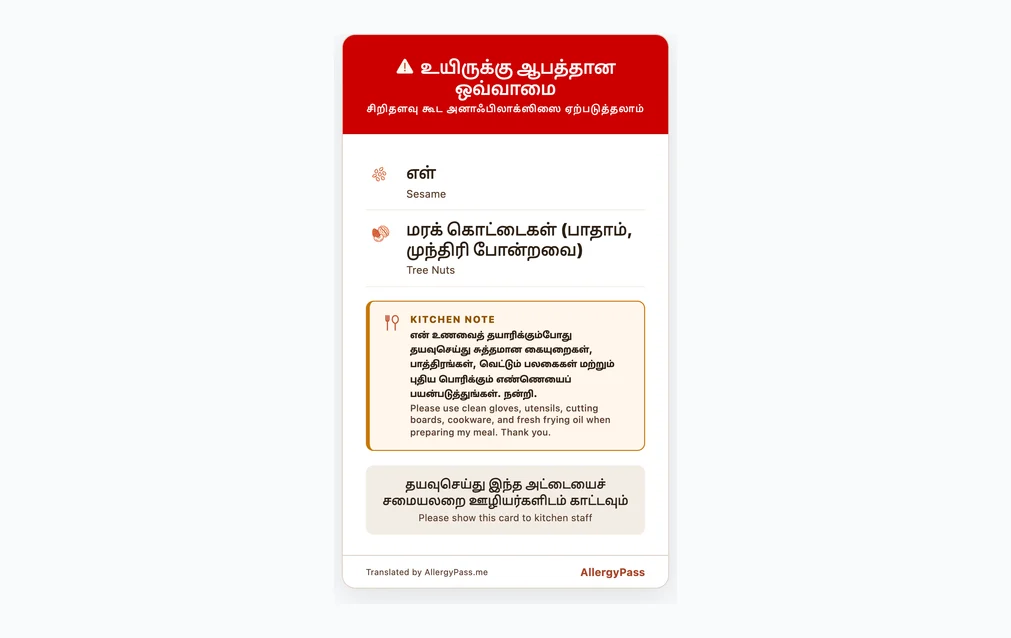
A live sample. Your finished card is personalized in the builder.
Get this card in Tamil
Your allergens, written in Tamil for kitchens in Tamil Nadu, Sri Lanka, Singapore and Malaysia, with the optional cross-contamination warning shown in this sample.
- Printable PDF with a cut-out card, plus an image for your phone
- Every allergen in Tamil and English, side by side
- Apple and Google Wallet passes for cards with up to three allergens
$7.99 one-time for Tamil English is free · All Languages $29.99 · instant digital delivery, no shipping charge
Continue with this cardSecure checkout by LemonSqueezy · 14-day refund policy
Where the Tamil card works
Tamil is spoken in Tamil Nadu, in northern and eastern Sri Lanka, and by long-settled communities in Singapore and Malaysia. In the Sinhala-speaking south of Sri Lanka, use the Sinhala allergy card instead.
Each of these 4 destinations is its own choice in the builder. A One Language card covers the destination you pick; All Languages covers every one of them.
What is the biggest risk in Tamil-speaking kitchens?
The hard part is rarely a headline ingredient. It is the thing a cook adds without thinking of it as an allergen: a spoon of oil to start the tempering, a handful of nuts to finish a sweet, a spoon of ghee over rice. The Tamil card is built around two groups that surprise travelers most often, sesame and tree nuts, and it works for any other allergen you add in the builder.
Sesame. Gingelly oil is sesame oil, and the question to put to a cook in Tamil Nadu or Jaffna is whether it is used for tempering, for frying or in pickles and spice powders. We have not found an official source that says how widely it is used, so treat it as a question rather than an assumption. It matters because India's allergen list does not name sesame, so a label or menu note will not warn you.
Tree nuts. Cashew is the nut to ask about. Ask whether the kurma is thickened with ground cashew, whether the pongal is finished with fried cashews, and whether the payasam or halwa carries them. These are questions, not claims about any particular kitchen, and the answer will change from place to place.
Other places to ask. Ask which fat is used for the dosa and the roti, since ghee is a common finish. Ask whether the vada fryer is also used for other items. Ask whether the chutney or the podi (the dry spice-and-lentil powder served with idli) includes peanuts. Where crab or prawn curries are on the menu, as in Jaffna, ask which dishes share the pot. In Singapore and Malaysia, ask about the sauce on rojak and satay, which is often built on peanuts and shrimp paste, and about the egg in roti canai and murtabak. If you have not chosen your allergens yet, the translation card overview explains how the wording works.
Why written Tamil beats spoken English
Tamil is spoken across four of our builder destinations, but the person at the stove is not always the person at the till. In a tiffin place the server may speak some English while the cook speaks none, and in a family-run restaurant in Jaffna the menu itself may be in Tamil only. A spoken "no nuts" passes through two or three people before it reaches the pan, and each hand-off loses a little. A card does not.
The card also fixes the vocabulary. Words for cashew, almond, groundnut and sesame differ from one region and one speaker to the next, and a traveler pointing at a menu cannot tell which is which. A card carries the same wording every time, in Tamil with English beneath so you can read it back. It gives the server something to hand across the pass, which is faster and clearer than repeating yourself at a busy counter.
A card cannot replace a conversation. Show it first, then ask the follow-up questions in this guide, and treat a vague answer as a no.
Allergen labelling: what the rules cover and what they do not
Four countries, four different situations. In each one, labelling law tells you more about packaged food than about a plate of food cooked to order.
India
India's Food Safety and Standards (Labelling and Display) Regulations, 2020 require foods known to cause allergy to be declared with a "Contains" statement. According to the FSSAI compendium on labelling and display, the list covers cereals containing gluten, crustaceans, milk, egg, fish, peanuts and tree nuts (almond, walnut, pistachio and cashew, declared as "Nut"), soybean, and sulphite at 10 mg/kg or more. Sesame, mustard and coconut are not on it, and oils derived from listed foods are exempt.
For restaurants, the same document says food service establishments should show allergen information against items on menu cards or boards (regulation 9(2)(a)), with some exemptions such as event caterers and special-order or modified items, and regulation 8(4) asks for allergen information at the point of sale for prepared food served for immediate consumption. We have not checked how consistently this is enforced, so do not expect it at a small restaurant. Ask.
Sri Lanka
Sri Lanka's food labelling rules have been through several rounds of postponement in the official gazette, and we could not read the allergen provisions closely enough to quote them. We therefore make no claim about what Sri Lankan law requires restaurants to declare. Plan as though a plate of rice and curry comes with no allergen information, and ask about it.
Singapore
The Singapore Food Agency's labelling guide says prepacked food must declare ingredients known to cause hypersensitivity. Its published list includes cereals containing gluten, crustaceans, eggs, fish and molluscs, peanuts and soybeans, milk, tree nuts (including cashew) and sulphites, and does not name sesame. The agency's consumer page on food allergy advises asking the food business directly. We found no allergen duty for hawker stalls, so the rules cover the packet and not the plate.
Malaysia
Malaysia's Ministry of Health has a guideline on labelling ingredients that may cause hypersensitivity. We could not confirm the allergen clause or its list from a readable official source, and we found no allergen rule for mamak stalls or restaurants. We make no legal claim here and suggest you rely on the question-and-card method.
Eating in Tamil Nadu: meals, tiffin and banana leaves
Tamil Nadu's kitchens work in Tamil, in Chennai, Madurai and Pondicherry alike, and that is where the written card does the most for you. Two formats cover most of what travelers eat.
"Meals" restaurants. You sit down, a banana leaf or steel plate is set, and waiters come round with rice and then buckets of sambar, rasam, kootu and curries, topping up as you eat. The set menu leaves little room for omissions, and the buckets are shared among every diner. Hand the card to the first server who arrives, before the leaf is filled, and ask which items to skip rather than waiting to refuse them one by one.
Tiffin places. Idli, dosa, vada, pongal and upma come with a tray of chutneys and sambar. Ask what the batter fat is, whether the same griddle or fryer serves other items, and whether chutneys include peanuts or coconut. If the answers are unclear, order the plainest item, such as plain idli, and keep the sauces on the side.
For the wider picture see our India food allergy hub. If your route continues west to Kerala, the neighbouring state works in Malayalam, and our Malayalam allergy card is the one to carry there. In an emergency in India, the single number is 112, which connects to police, fire and ambulance (national emergency response system).
Eating in northern and eastern Sri Lanka and the hill country
Tamil is one of Sri Lanka's two official languages alongside Sinhala, as the country's constitution sets out. In practice the kitchen language depends on where you are. Jaffna, Trincomalee, Batticaloa and the hill-country estates work in Tamil, while the Sinhala-speaking south and west (Colombo, Galle, Kandy, Ella) mostly do not. Colombo is mixed, with Sinhala, Tamil and English all heard. If your trip covers the south, the Sinhala allergy card is the companion to carry.
Eating in Jaffna means small family-run restaurants, often with Tamil-language menus and fewer English speakers than the capital. The cooking is its own tradition, and crab curry is a well-known local dish. If you eat shellfish-free or nut-free, ask what goes into the curry and the sambols, ask which dishes share a pot, and ask whether gingelly oil is used. Do not assume a dish is safe because it sounds vegetarian.
The ambulance number is 1990, the free Suwa Seriya service. For routes, hospitals and what to do after a reaction, read our Sri Lanka food allergy guide.
Eating in Singapore: Little India and the hawker centres
Tamil is one of four official languages in Singapore, listed in Article 153A of the Constitution with Malay, Mandarin and English. That does not mean every stall will have a Tamil menu, but it is a reason a Tamil card may be read without fuss in Little India.
Communication here is usually easier than elsewhere on this page, since stallholders speak English, Tamil or Mandarin depending on the stall. The difficulty is ingredients. Gravies, chutneys and fried items are not labelled, and the rules described above cover only prepacked food. Show the card, name the allergen, and ask what the sauce and the frying oil contain.
The emergency number for an ambulance is 995, run by SCDF. Our Singapore food allergy hub collects the rest.
Eating in Malaysia: mamak stalls and banana-leaf rice
Tamil is not an official language in Malaysia, but you may hear it in Indian-run restaurants, and banana-leaf rice places and mamak stalls (open late, serving roti canai, murtabak and teh tarik) are where a Tamil card helps. Many orders at a mamak stall are cooked on one shared griddle, and roti canai and murtabak are often made with egg, so ask about both if egg is on your card.
Banana-leaf service works like a Tamil Nadu "meals" restaurant: rice first, then ladles of curries. Show the card at the start, and ask which curries carry nuts or shellfish. Malaysia's national language is Malay, so the Malay allergy card is a sensible second card for the same trip, and our Malaysia food allergy hub covers the wider country. The emergency number is 999, the MERS 999 line.
What happens after you pay, and what to check
You pick your allergens in the builder, choose the severity wording and whether to include the cross-contact request, and check the preview. The card arrives by email as a printable PDF with a cut-out card and as an image for your phone. Everything is delivered digitally, so nothing is shipped.
Before you travel, read the Tamil on the preview with someone who reads it if you can, print one copy for your bag, and keep the image on your phone for when the printed copy is wet or lost. A One Language purchase is tied to a single destination. If you plan to eat in more than one Tamil destination, choose the destination that matches your first stop, or consider the All Languages option, which covers every language.
Frequently asked questions
What do you get with the Tamil allergy card?
A printable PDF with a cut-out card and an image sized for your phone, with each allergen you pick written in Tamil and English side by side. Apple and Google Wallet passes are included in the paid tiers, for cards with up to three allergens.
Is the Tamil card the right one for Sri Lanka's south?
Not usually. Kitchens in Colombo, Galle, Kandy and Ella mostly work in Sinhala, while Tamil is the kitchen language in Jaffna, the east and the hill-country estates. Pick the card that matches the kitchen you are standing in, and check the Sinhala card if your route runs through the south.
Does an Indian food label list sesame?
Not necessarily. The allergen list in India's labelling rules names cereals with gluten, crustaceans, milk, egg, fish, peanuts and tree nuts, soybean and sulphite, and sesame is not on it. Treat the absence of a warning as no information about sesame, and ask about gingelly oil and seeds directly.
Does Singapore require allergen information at hawker stalls?
Singapore's published allergen rules are written for prepacked food. We found no equivalent duty for hawker stalls on the Singapore Food Agency's pages, so ask the stallholder what is in the gravy, the chutney and the frying oil, and show the card while you do.
Is Tamil an official language in Malaysia?
No, so do not expect menus or official signs in Tamil there. A written card still helps at banana-leaf restaurants and mamak stalls, where the cook may read Tamil or Malay more easily than English. The Malay card is a useful second option for the same trip.
Does the card guarantee a safe meal?
No. It tells the kitchen exactly what to avoid in their own language, but it cannot control shared pots, shared griddles or a cook who is not paying attention. Confirm the dish with staff, and carry your prescribed emergency medication.
This article is for informational and travel preparation purposes only and does not constitute medical advice. Always consult a qualified healthcare professional before traveling with a food allergy, and carry any prescribed emergency medication at all times. See our full medical disclaimer.