 AllergyPass
Arabic allergy card
Your restrictions in Arabic and English, ready to save on your phone or print.

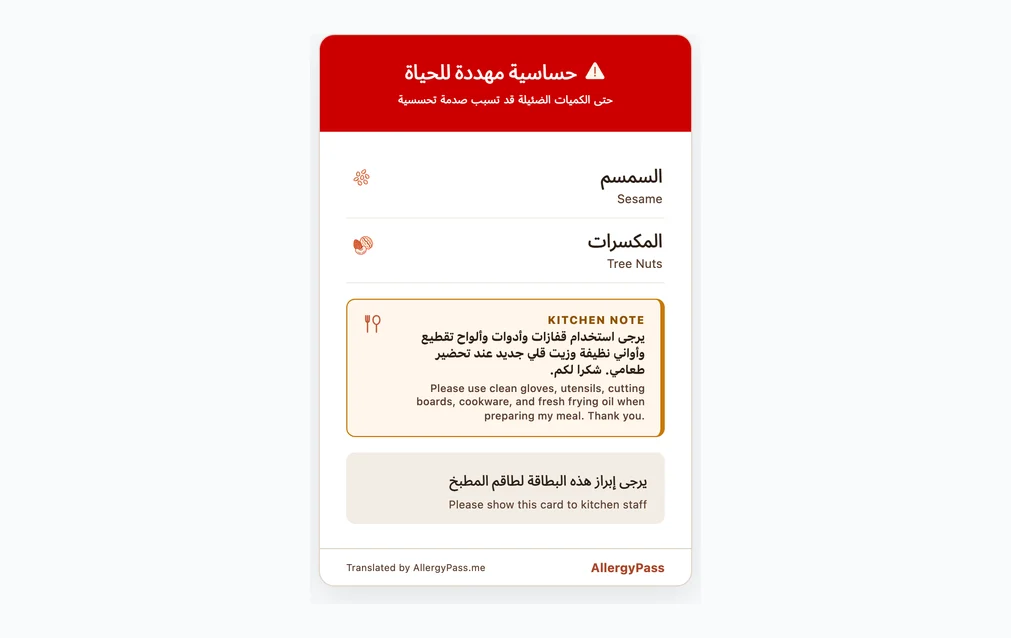
A live sample. Your finished card is personalized in the builder.
Get this card in Arabic
Your allergens, written in Arabic for kitchens in the Middle East and North Africa, with the optional cross-contamination warning shown in this sample.
- Printable PDF with a cut-out card, plus an image for your phone
- Every allergen in Arabic and English, side by side
- Apple and Google Wallet passes for cards with up to three allergens
$7.99 one-time for Arabic English is free · All Languages $29.99 · instant digital delivery, no shipping charge
Continue with this cardSecure checkout by LemonSqueezy · 14-day refund policy
Where the Arabic card works
The same Arabic card is offered for every Arabic-speaking destination in the builder, from the Gulf and the Levant to Egypt and North Africa. In Morocco, Algeria and Tunisia many menus also use French; the French allergy card covers that.
- United Arab Emirates
- Algeria
- Bahrain
- Egypt
- Iraq
- Jordan
- Kuwait
- Lebanon
- Morocco
- Oman
- Qatar
- Saudi Arabia
- Syria
- Tunisia
- Yemen
Each of these 15 destinations is its own choice in the builder. A One Language card covers the destination you pick; All Languages covers every one of them.
What is the biggest risk across the Arabic-speaking world?
Sesame and tree nuts. Both are central to Arabic-region cooking, and neither is always named on a menu. Tahini, which is ground sesame, goes into mutabbal (roasted aubergine with tahini), into hummus and msabbaha, and into the dressings poured over falafel and shawarma. Visit Jordan's food brochure also describes za'atar as thyme blended with sesame seeds and sumac, so a flatbread brushed with za'atar can carry sesame even when no seed is visible.
Nuts hide in sweets and in savory rice. The same brochure lists knafeh with pistachio, other pastries stuffed with pistachios and walnuts, and pine nuts scattered over meat and rice dishes. Fattet hummus is another trap: chickpeas and tahini over pieces of pita (wheat), with yoghurt (milk) and often almonds or pine nuts on top. A single plate can touch four allergens before you have taken a bite.
Wheat is the third quiet one. Abu Dhabi's tourism board describes harees as a slow-cooked porridge of wheat and meat, and UNESCO's entry on couscous says it is made from ground and rolled cereal seeds. Ask rather than guess: "is there tahini or any nut in this, including the garnish?" is a better question than "is this safe?". Our guides to hidden allergens in Egyptian food and sesame allergy travel go deeper on both.
Why a written Arabic card beats spoken English
An allergy explained out loud has to survive a noisy room, a busy server and a second hand-off to the cook. A card does not get shortened along the way. The person at the table reads it, the person at the stove reads the same words, and nobody has to guess what "tree nut" covers.
The Arabic card is laid out right to left for Arabic readers, with your English alongside so you can check what you are handing over. Every allergen you choose appears on it, together with the severity wording and the optional cross-contact request. Because the printed card names the allergens in plain terms, it also works for staff who understand the dish perfectly but have never been asked about an allergy in English.
A card is a communication aid, not a guarantee. Use it to start a real conversation: show it before you order, ask how the dish is made, and walk away from anything the kitchen cannot answer clearly.
Allergen labelling across the region
The rules differ by country, and the biggest split is between packaged food and food served in restaurants. For packaged food, the Gulf labeling standard GSO 9/2013 requires hypersensitivity-causing ingredients to be declared, among them gluten cereals, peanuts, walnuts, milk, sesame and lupin. The Gulf Standardization Organization's project page shows that a newer technical regulation, GSO 2810:2025, now covers allergen declarations on prepackaged food. We did not read its text, so we do not quote its contents here.
For restaurants the picture is patchier. Saudi Arabia and Dubai have written menu rules, covered in the regional notes below. For Jordan, Lebanon, Egypt, Algeria and Tunisia we could not verify any rule that makes restaurants list allergens, so treat the menu as incomplete everywhere you have not confirmed otherwise.
Real dining situations
Mezze is the first test. Shared plates of hummus, mutabbal and fattet arrive together, and tahini or nuts sit on most of them. Show the card to the server before ordering and ask for the dishes you can eat to be prepared from clean bowls and serving spoons, since a spoon that has been in the tahini dip is a cross-contact route.
Buffets are the second. Hotel buffets and Ramadan iftar spreads, which Abu Dhabi's tourism board describes as ranging from communal to intimate, with live cooking stations, mean many sauces and sides you cannot trace. Find the chef or a manager rather than a runner, hand over the card, and ask which items are made without your allergen and are served with their own utensils. Self-serve stations with shared spoons are the weakest point.
Street stands, cafes and bakeries work best when the dish is short and the cook can answer in a sentence. Show the card, point to the allergen, and ask whether the sauce, the dough or the topping contains it. Pastry counters deserve special care, because sesame or nuts from one tray can end up on the one beside it.
What happens after you pay, and what to check
Pick Arabic in the builder, choose your allergens, and the card is built from those choices. The PDF and phone image are emailed to you, and cards with up to three allergens can also be saved to Apple or Google Wallet. There are no download buttons on the page itself, so use an email address you can open on your phone.
Before you travel, check three things. First, read the English side of the card slowly and confirm that every allergen you meant is there. Second, decide whether to switch on the severe-allergy wording and the cross-contact request, both of which you can preview on the sample above. Third, save the image where you can reach it offline, and print one copy as a backup for a dead battery.
The Arabic card is sold per destination under One Language: choose the country you are visiting in the builder and the card covers that destination. If your itinerary spans several Arabic-speaking countries, All Languages covers every language we offer, Arabic included.
Regional notes: the Gulf, the Levant, Egypt and the Maghreb
The builder offers Arabic for 15 destinations: the UAE, Saudi Arabia, Qatar, Kuwait, Bahrain, Oman, Jordan, Lebanon, Syria, Iraq, Yemen, Egypt, Morocco, Algeria and Tunisia. The facts below are the ones we could confirm from official or primary sources, and they are not complete for every country.
The Gulf
Saudi Arabia has the clearest restaurant rule we found. The Saudi Food and Drug Authority's Technical Regulation No. 56, effective 1 October 2019, requires food establishments serving customers outside the home to disclose allergens on their menus. The disclosure must be permanent, clear and in Arabic, and may also be translated into other languages. It covers restaurants, cafes, bakeries, kiosks, delivery companies and caterers, and the SFDA lists 14 allergens, including tree nuts, sesame, milk, gluten cereals, peanuts and mustard.
In Dubai, the municipality's Food Code asks food service establishments to declare common allergenic ingredients on the label or the menu, and for food prepared for immediate consumption to display allergen information or provide it on request. Its list includes peanuts, tree nuts, sesame, milk, egg, soybeans, fish, crustaceans and gluten cereals. The Code also says menus should be printed in Arabic and English with allergen-containing items clearly identified, and that establishments offering allergen-free food should have a competent person on each shift. We read the 2013 edition and cannot confirm there is no later one, and we did not research the other emirates. A rule on paper does not guarantee the answer you get, but it gives your question a footing.
For emergencies, the UAE government lists police 999, ambulance 998 and civil defence 997. We could not confirm Saudi, Qatari, Kuwaiti, Bahraini or Omani numbers from an official page, so look them up before you go.
The Levant
We could not verify an allergen-labelling rule for Jordan or Lebanon, and we found nothing confirming that restaurants there must list allergens. Syria was not researched. In practice, that means mezze tables in Amman or Beirut call for the full routine: show the card, then ask about tahini, za'atar, pine nuts and pistachio pastries by name.
In Jordan, the UK government's travel advice gives 911 as the emergency number. In Lebanon, the Lebanese Red Cross runs a national medical emergency hotline on 140.
Egypt
Egypt's National Food Safety Authority regulates labeling. A US government summary of Egyptian import rules says prepackaged foods for special dietary uses must list ingredients, additives and foods that may cause allergies. We could not confirm a general allergen list for ordinary packaged food, or any menu rule for restaurants, so we make no claim on either.
Koshari is the everyday dish. UNESCO's listing describes it as rice, pasta, black lentils and fried onions with vinegar, garlic and hot sauce, sold from carts and restaurants. Pasta means wheat, and everything is mixed in one bowl, so an ingredient cannot be picked out afterward. Read more in our Egypt food allergy hub, the guide to hidden allergens in Egyptian food and the Egypt emergency healthcare guide.
The Maghreb
Morocco's labeling decree, 2-12-389, lists 14 allergens that must be named on prepackaged food: gluten cereals, crustaceans, eggs, fish, peanuts, soy, milk, tree nuts, celery, mustard, sesame, sulphites, lupin and molluscs. We read the text on the government's SGG site, where the file is titled as a draft, so the final wording may differ. The duty applies to packaged products. We found no equivalent rule that makes restaurants or stalls list allergens, so in a medina restaurant the only route is to ask. Algeria and Tunisia were not researched.
Couscous, tagines and pastries are the main dishes to ask about. Morocco's tourist board says tagine ingredients sometimes include nuts, and names pastilla and mrouzia among the emblematic dishes. We could not confirm their recipes from an official source, so ask what is in each. Our Morocco food allergy hub and Morocco emergency healthcare guide have more. The UK government's advice gives 150 for ambulance and fire, and 190 for police.
French is also widely used in the Maghreb. The International Organisation of la Francophonie's 2026 report describes it as still used in media, university, administration and the economy, while also noting that its position there is contested. That is not the same as everyone speaking it, which is why the Arabic card remains the base layer. If you will spend time in business hotels or administrative offices, a second card from our French allergy card page can help.
Frequently asked questions
Does one Arabic card work across the Middle East and North Africa?
The same Arabic card is offered for each of the 15 destinations in the builder. You pick the country when you build it, and each destination is its own One Language purchase. If you are visiting several, All Languages covers every language we offer.
Do restaurants in Saudi Arabia have to list allergens?
Saudi Technical Regulation No. 56, effective 1 October 2019, requires food establishments serving customers outside the home to disclose allergens on their menus in Arabic. Whether a particular menu follows it is another matter, so still show your card and ask.
Is French better in Morocco, Algeria or Tunisia?
French is widely used in business, media and administration there, but not everyone speaks it, and the OIF notes its position is contested. The Arabic card reaches the broadest range of kitchens. A French card can be a useful second option in places where French is the working language.
Does the card display right to left?
Yes. The card is laid out right to left for Arabic readers, with your English alongside it so you can check every line.
What do you get with the Arabic allergy card?
A printable PDF with a cut-out card and an image for your phone, delivered by email. Cards with up to three allergens can also be added to Apple or Google Wallet.
This article is for informational and travel preparation purposes only and does not constitute medical advice. Always consult a qualified healthcare professional before traveling with a food allergy, and carry any prescribed emergency medication at all times. See our full medical disclaimer.