 AllergyPass
Hungarian allergy card
Your restrictions in Hungarian and English, ready to save on your phone or print.

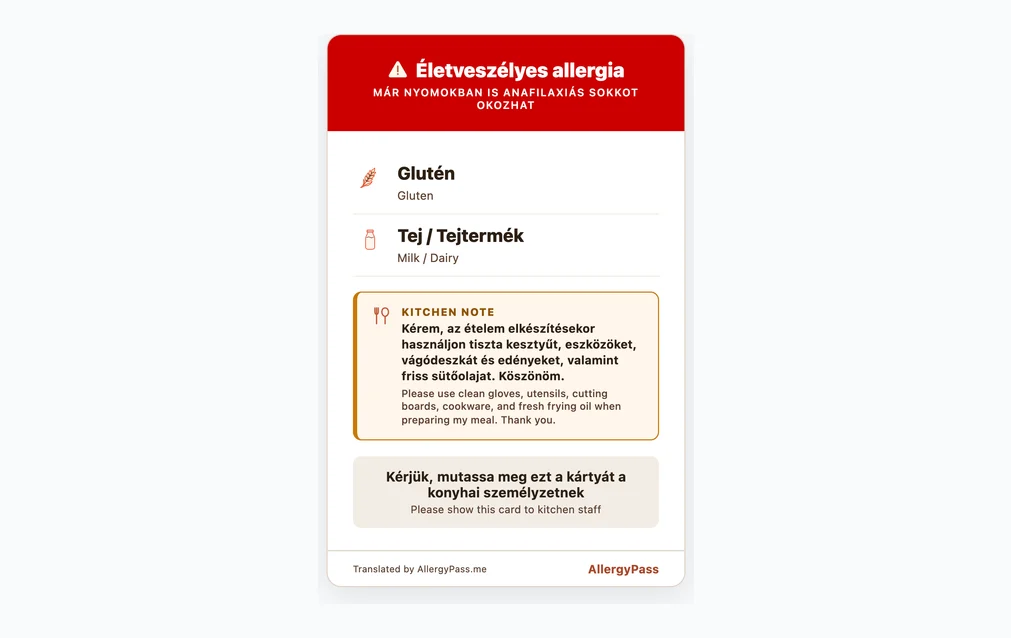
A live sample. Your finished card is personalized in the builder.
Get this card in Hungarian
Your allergens, written in Hungarian for kitchens in Hungary, with the optional cross-contamination warning shown in this sample.
- Printable PDF with a cut-out card, plus an image for your phone
- Every allergen in Hungarian and English, side by side
- Apple and Google Wallet passes for cards with up to three allergens
$7.99 one-time for Hungarian English is free · All Languages $29.99 · instant digital delivery, no shipping charge
Continue with this cardSecure checkout by LemonSqueezy · 14-day refund policy
What is the biggest risk in Hungary?
Hungarian cooking hides its allergens in the things that come with a dish rather than in its name. Sour cream, tejföl, is the obvious one: the Hungarian Tourism Agency describes it as a staple of Hungarian cooking, spooned onto soups, vegetable stews and lángos. Potato pancakes from street stalls are usually served with sour cream too. If dairy is your allergy, assume a topping is coming unless you ask for the plate without it.
Wheat and egg arrive the same way. Paprikás and pörkölt usually come with nokedli, small dumplings made from flour, eggs and salt, and they are served automatically. Many soups and vegetable stews (főzelék) are thickened, and the method varies by cook, so ask whether flour was used. Fish soup, halászlé, is made from river fish, and in the Baja style it is served with pasta.
Tree nuts are the third pattern, and the most seasonal. Walnut fills beigli, the rolled cake that appears at every Christmas table, and it is inside zserbó slices and Gundel pancakes, according to the tourism agency's guide to Hungarian desserts. Chimney cake, kürtőskalács, can be rolled in ground walnut or hazelnut at the stall. A plain-looking slice in a pastry case can still carry nuts in the filling, so ask about each one.
Fresh curd cheese, túró, is a separate dairy risk because it does not look like cheese. It goes into túrós csusza, noodles with túró and bacon, and into sweets such as túrógombóc dumplings. The tourism agency's food glossary describes túró as a fresh, crumbly cheese. If milk is on your card, ask about any dish whose name includes túró.
Why written Hungarian beats spoken English
In Budapest's central districts plenty of staff speak English, but the kitchen is often a different matter, and outside the capital English drops away quickly. Hungarian food words are also hard to guess from English: tejföl, túró and nokedli give a visitor nothing to recognize, and a cook hearing an English allergen name has to translate it in a busy moment.
The legal setup makes the written card more useful, not less. Hungarian restaurants are allowed to give allergen information out loud (see the next section), which means your question can pass through two people before it reaches the stove. A card in Hungarian travels with the order, can be shown directly to the cook, and does not depend on anyone remembering what you said at the table.
Put your selected allergens in Hungarian and English on a card to show kitchen staff.
Build my Hungarian cardAllergen labelling in Hungary
Hungary applies the EU food information rules, Regulation (EU) No 1169/2011, whose Annex II lists 14 allergens that must be declared: cereals containing gluten, crustaceans, eggs, fish, peanuts, soybeans, milk, tree nuts, celery, mustard, sesame, sulphites, lupin and molluscs. Those rules also cover food that is not prepacked, which includes restaurant meals.
How a Hungarian restaurant meets that duty is set out in a national decree, 36/2014 (XII. 17.) FM, and explained in the allergen guide published by Nébih, the national food chain safety authority. The guide says a restaurant must display a notice telling guests where allergen information is available, and the information must be given before the meal is ordered. It can be written, listing the allergens dish by dish, or spoken. When it is spoken, it must come from trained staff working from a written ingredient record that can be shown on request.
In practice that means you are entitled to an answer, but not necessarily to a printed allergen list. Ask to see the written record when an answer sounds uncertain, and remember that poppy seed, common in Hungarian baking, is not one of the 14 EU allergens, so it may not appear on any list at all.
Real dining situations in Hungary
Daily set lunch. Many restaurants and small lunch counters (étkezde, kifőzde) offer a napi menü, a soup and main at a fixed price, written on a board in Hungarian. It moves fast, so show your card before you order and ask which of the two courses can be made without your allergens, rather than trying to change a dish once it is plated.
Csárda and traditional restaurants. These are where sour cream, dumplings and thickened sauces are most likely. Hand over the card when you sit down, and ask specifically about the side dish and the topping, since that is where the allergens usually are.
Pastry shops (cukrászda). Cakes are sold unwrapped from a counter, so you are relying on what staff tell you. Show the card and ask about the filling and any coating. If the answer is vague, choose something else.
Market halls and street stalls. Lángos and chimney cake are made to order in front of you, which helps: you can watch what goes on. Show the card before the topping or coating is added, and ask what the dough is made with if milk or egg is on your list.
What happens after you pay, and what to check
Choose your allergens in the builder, decide whether the card should include a severe-allergy line and a request to avoid shared equipment, then check out. The card is emailed to you twice over: a printable PDF with a cut-out version for your wallet, and an image sized to your phone screen. With three allergens or fewer you can also add it to Apple or Google Wallet. Nothing is posted to you.
Before the trip, read the card once on your phone and once on paper, keep the image saved on your device so it opens without signal, and put the printed copy where you can reach it at the table. One Language covers Hungary. If Hungary is one stop on a longer European route, All Languages covers every language we offer, including any added later.
If something goes wrong
Hungary's emergency number is 112, answered around the clock in Hungarian, English and German, and free from any phone. Carry your prescribed emergency medication, and do not wait to see whether a reaction settles before calling.
Frequently asked questions
What do you get with the Hungarian allergy card?
A printable PDF with a cut-out card and an image sized for your phone, both sent by email. Every allergen you choose is written in Hungarian with the English underneath. Cards with up to three allergens can also go into Apple or Google Wallet.
Do restaurants in Hungary have to tell you about allergens?
Yes. Under EU rules and Hungarian guidance from the food chain safety authority, Nébih, a restaurant must tell you where allergen information is available and give it before you order. It can be given in writing or out loud by trained staff, so you may get a spoken answer rather than a printed list.
Is walnut common in Hungarian desserts?
Very. Beigli, zserbó and Gundel pancakes are all made with walnut, and chimney cake stalls offer a ground walnut or hazelnut coating. If tree nuts are on your card, ask about every pastry and cake, including the ones that look plain.
Is sour cream really in everything?
It is a staple. Hungarian cooks put tejföl on soups, vegetable stews, potato pancakes and lángos, and lángos dough itself is made with milk. If dairy is on your card, ask for dishes without it before they are plated, not after.
What is the emergency number in Hungary?
112 works across Hungary around the clock, and calls can be taken in Hungarian, English and German. Keep your prescribed emergency medication on you.
This article is for informational and travel preparation purposes only and does not constitute medical advice. Always consult a qualified healthcare professional before traveling with a food allergy, and carry any prescribed emergency medication at all times. See our full medical disclaimer.