 AllergyPass
Italian Gluten Free Card:
A Celiac Card for Italy
Explain celiac disease and your dietary needs with an Italian-English card. Show it to restaurant staff, then ask how the kitchen prevents gluten cross-contact.
 Italy
Italy
Get your celiac card for Italy
Explain celiac disease and your dietary needs with an Italian-English card.
Build My Italian Celiac CardWhat AIC’s gluten-free dining programme covers
AIC’s current AFC listings identify participating venues. Visiting travelers can purchase temporary AIC Mobile Welcome access. Check the official listing rather than relying on a sticker or a map result alone.
AFC participation concerns gluten-free preparation. It does not establish that a venue can accommodate other allergies. If you also avoid milk, egg or nuts, discuss those separately and use the Italian allergy card to name your full set of restrictions.
At any restaurant, ask which dishes can be prepared for someone with celiac disease. AIC’s preparation rules address ingredients, cooking water and equipment. A card supports the conversation; it cannot establish what happens in the kitchen.
The cross-contact risks specific to Italian kitchens
Pasta, fried foods, pizza and bread service each raise preparation questions. Check these alongside the ingredients:
None of these four are visible on a menu. They are kitchen habits, and the only way to find out whether a given restaurant handles them carefully is to ask, which is what the card is for.
Build an Italian-English celiac card, then ask staff about pasta water, fryer oil and preparation surfaces
Build My Italian Celiac CardWhy a written card beats spoken Italian in a busy kitchen
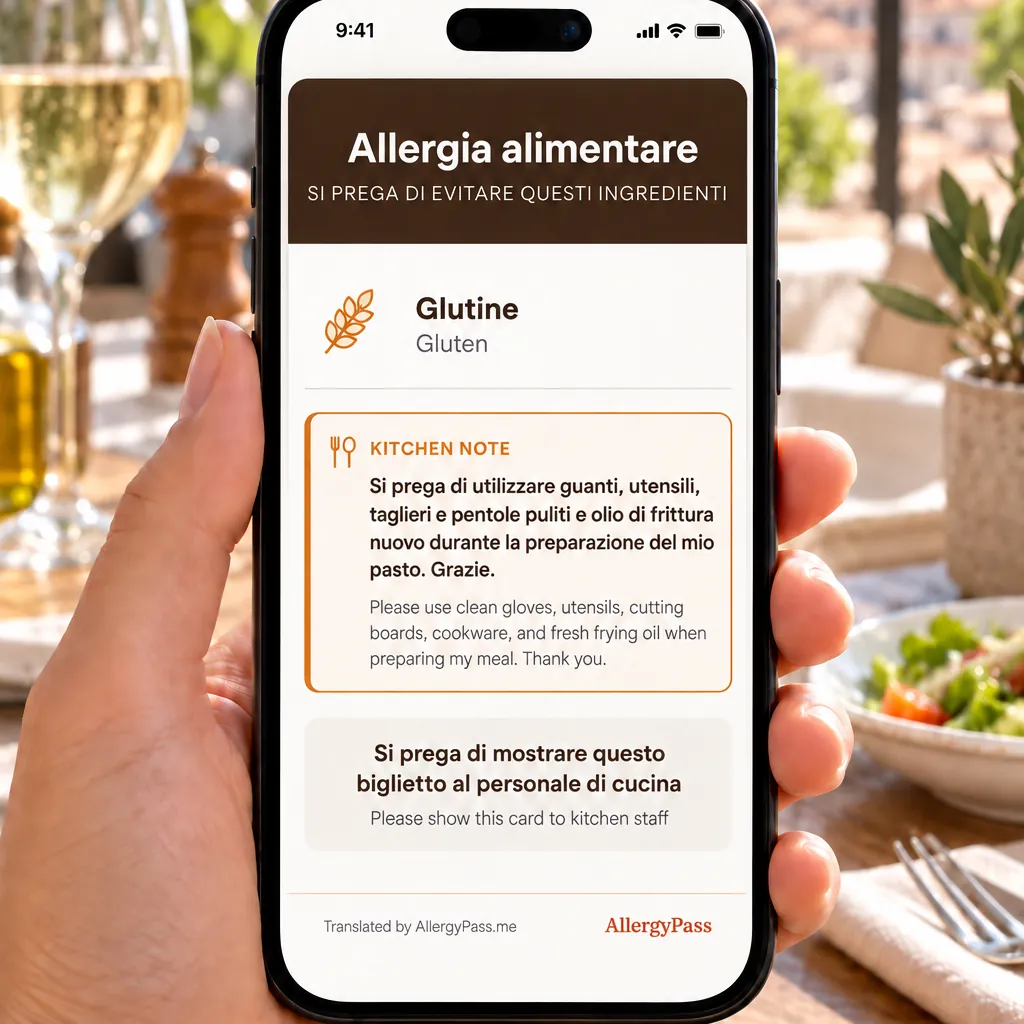
Even travelers with decent Italian run into the same problem at a busy trattoria: a rushed server hears "gluten-free," nods, and moves on before the sentence about cross-contact lands. A written card removes that failure point. It gives the person taking your order something to read and hand to the kitchen directly, at whatever pace the shift allows, rather than something they have to parse and remember correctly under pressure.
It is still not a guarantee. Show the card before ordering, watch for a clear answer about pasta water and fryer oil specifically, not just a nod, and choose something else if the kitchen cannot answer. A card starts the right conversation; it does not replace it. That is the same premise behind our broader translation card guide, and the same limitation the celiac travel guide notes about every destination, not just Italy.
Finding gluten-free food in Italy
Check supermarkets and pharmacies for packaged gluten-free products, and read the actual label. The crossed-grain mark is used on qualifying products; it is not a substitute for checking whether a restaurant currently participates in AIC’s AFC programme.
Dedicated gluten-free bakeries and restaurants can be useful places to investigate, but still ask about ingredients and handling. For destination planning, see the Italy food allergy guide and its guides to Rome, Milan, Venice and Florence.
Frequently asked questions
Do I need a special gluten free card for Italy?
A card can help you explain celiac disease and your preparation needs in writing. It should support a direct conversation with staff about ingredients and handling. It does not guarantee that a restaurant can accommodate you.
What does AIC participation mean for a restaurant?
Participating AFC venues receive gluten-free training and follow programme requirements. Check AIC’s current official listings before visiting. The programme concerns gluten-free preparation; ask separately about any other allergies.
Is pasta safe for celiacs in Italy?
Check that the pasta and sauce are gluten-free and that staff use fresh cooking water, a clean pot and a clean strainer. A gluten-free pasta option on the menu does not by itself answer these preparation questions.
Which cross-contact risks should I ask about?
Ask about water used for wheat pasta, oil shared with breaded foods, flour on work surfaces and pizza peels, and crumbs on serving equipment. Check ingredients as well as handling; the relevant risks depend on the kitchen.
This article is for informational and travel preparation purposes only and does not constitute medical advice. Always consult a qualified healthcare professional before traveling with a food allergy, and carry any prescribed emergency medication at all times. See our full medical disclaimer.