 AllergyPass
Food Tours in Vietnam
with Food Allergies
A Vietnam food tour can work with a food allergy, but only when the operator can explain what you will eat and how each stop will be handled. Fish sauce, shrimp paste, peanuts, shared utensils, and fast-moving tasting stops all need to be discussed before you book.
 Vietnam
The core allergen problem in Vietnamese food tours
Nuoc mam, fermented fish sauce, often appears in broths, marinades, dipping sauces, and seasoning mixes. It may be added before a dish reaches the table, so asking for “no fish sauce on top” is not enough. Ask whether it is in the broth, marinade, dipping bowl, or pre-mixed seasoning for each pho, banh mi, or spring-roll stop.
Shrimp paste (mam tom, mam ruoc) can be a condiment, a sauce ingredient, or part of a regional recipe such as bun bo Hue or banh xeo. Peanuts may be mixed into a dish or scattered on top of goi cuon, cao lau, and some banh mi fillings. Removing visible peanuts does not address a shared chopping board, mortar, wok, or serving spoon.
The full hidden allergen breakdown is in the Hidden Allergens in Vietnamese Food guide. Reading it before booking any food tour is worth the time.
Compare the tour format before you book
City by city: food tour allergy considerations
Hoi An
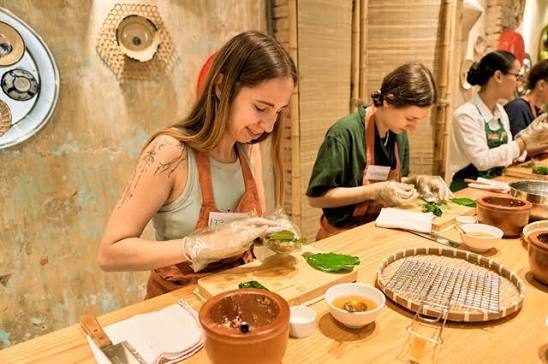
Hoi An tours often combine market visits, cooking classes, and small restaurants. That mix can work well only if the operator tells you which parts involve tasting and which are simply sightseeing. Ask whether the class or restaurant has its own kitchen, whether the menu is fixed, and whether the guide will check cao lau, white rose dumplings, sauces, and garnishes individually rather than relying on the dish name.
Cao lau may include peanuts or a prepared broth that needs checking. White rose dumplings are made with shrimp, so they are not a neutral tasting option for shellfish-allergy travelers. With banh mi, ask about the pâté, mayonnaise, pickles, sauces, bread, and the knife or board used for fillings.

Ho Chi Minh City
A tour here may include several short stops, so the important question is not the district but the operator's process. Ask for the actual route and dish list. If the itinerary includes a market or busy street stall, confirm whether you can watch without tasting and whether there is a sit-down alternative when a vendor cannot answer.
Around busy markets, noise and pace can make a careful conversation difficult. Ask the guide to show the allergy card to the vendor before anything is ordered, and do not accept a dish simply because the visible garnish was removed. Shared woks, oil, tongs, chopping boards, and dipping bowls can matter as much as the recipe.
Hanoi
Hanoi's Old Quarter is a fast-moving environment with many small vendors and shared cooking surfaces. Before booking, ask whether the tour is primarily street stalls, whether stops can be skipped, and whether the guide has time to speak with each vendor. If the answer is no, choose a tour with fewer stops or treat the route as a walking tour and bring food you already trust.
How to screen operators before booking
Send the same questions in writing before you pay. The goal is to learn what the operator will do at each stop, not to get a general “yes.”
- Can you send the planned stops and dishes, including sauces, broths, marinades, garnishes, and drinks?
- Will the guide show my allergy card and speak with each vendor before food is ordered?
- How are nuoc mam, mam tom, peanuts, sesame, soy, wheat, and shared seasonings handled at each stop?
- Are the wok, oil, tongs, chopping board, mortar, serving spoon, and dipping bowl shared?
- Can I watch without tasting, and can the guide replace a stop if the vendor cannot answer?
- What is the group size, and can I book a private or smaller tour with enough time for questions?
The reply should contain practical details: named dishes, preparation steps, and a plan for an unanswered question. “We can accommodate allergies” without those details is not a booking decision.
When to decline a tasting stop
Tell the guide you are skipping the stop when the vendor cannot identify an ingredient, the answer changes when you ask about sauces or broth, or the proposed fix is only to remove a visible garnish. Also skip when the food is cooked in shared oil or on shared equipment that the operator cannot explain, when a communal dipping bowl is involved, or when the group is moving on before you have an answer. A good operator should make skipping ordinary, not awkward.
Carry your prescribed medication and a backup snack. You may still enjoy the market, the explanation, or the walk even when you do not eat the sample.
This article is for informational and travel preparation purposes only and does not constitute medical advice. Always consult a qualified healthcare professional before traveling with a food allergy, and carry any prescribed emergency medication at all times. See our full medical disclaimer.